Core Technology
Our core technologies are the direct fruit of research at the Machining and Tribology Laboratory of Nagoya Institute of Technology. Tribology that “uses surfaces” and precision machining that “creates surfaces”—being able to commercialize both as the researchers behind them is what makes Three-labs unique.
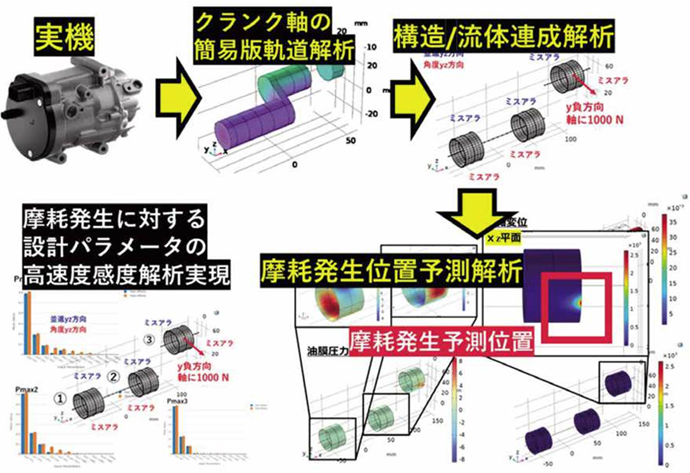
Tribology: The Technology of Utilizing Surfaces
Tribology is the science of “phenomena that happen at surfaces”—friction, lubrication, and wear. A machine's performance, lifespan, and maintenance cost are all heavily shaped by these surface phenomena. We apply our research insight in this field directly to solving challenges in the manufacturing industry.
Research Examples
- Tribology CAE (high-accuracy simulation of friction and wear) — Predicting complex friction and wear phenomena with high accuracy through CAE to cut prototyping steps out of manufacturing. Applied to predicting wear locations in compressor bearings and to building the friction-coefficient database used in metal-forming die design. Developed in the “Knowledge Hub Aichi” Priority Research Project, it is the founding technology of Three-labs.
- Surface-texture control that suppresses pitting in rolling bearings — A rolling bearing runs on an oil film only submicrons thick, so micron-scale asperities on the surface become contact points that trigger damage. By controlling surface texture through machining, we reduced this contact and extended bearing life.
- Understanding the “running-in” process of bearings — Analyzing how contact surfaces bed in during early operation—from the effects of operating patterns and lubricant additives—to predict changes in load capacity and inform design.
We put these insights to work directly for our clients through technical consulting. To Technical Consulting →
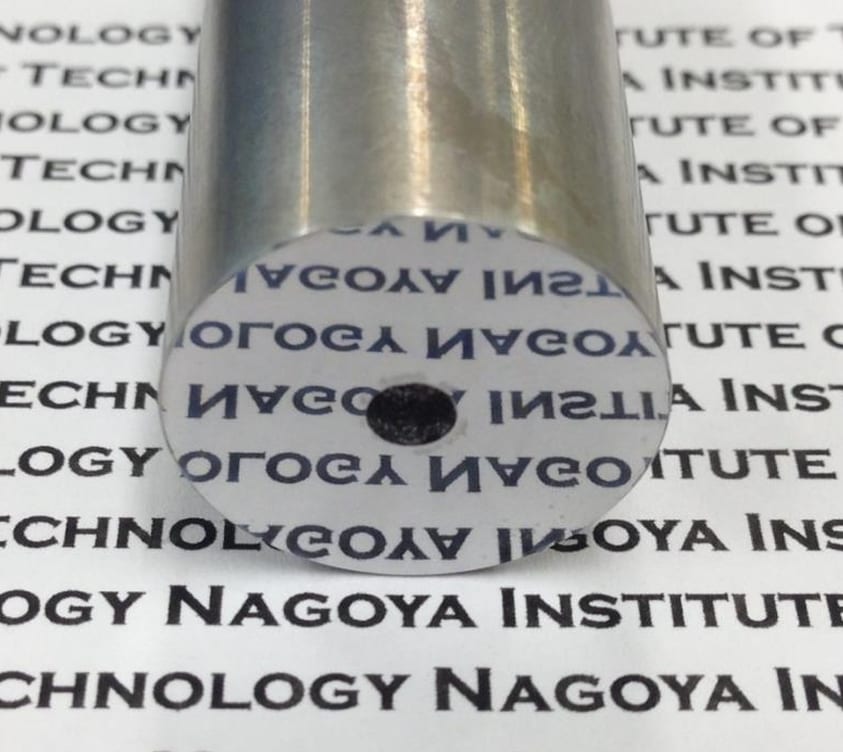
Precision Machining: The Technology of Creating Surfaces
Precision machining shapes materials to high accuracy—it “creates” the surface of a product. Automotive, aircraft, medical devices, semiconductors: the higher the reliability an industry demands, the more the quality of the tools and the machining process determines the quality of the product.
Research Examples
- PLG (Pulse Laser Grinding): shaping tool edges with ultra-short-pulse lasers — Removing the fine irregularities and chips left on commercial diamond tools to create a sharp, damage-free edge—turning the machining of hard, brittle materials from “abrasive grinding” into “laser processing.” A core technology of Three-labs, long pioneered by our parent Machining and Tribology Laboratory.
- High-speed machining of hard-to-cut materials — Developing cutting technology for difficult materials such as the nickel heat-resistant alloys used in next-generation aircraft and automobiles, achieving roughly five times the conventional machining speed.
- Environmentally conscious machining (MQL) — Using minimum quantity lubrication and related methods to suppress friction between tool and workpiece while keeping the environmental load low.
This research is available to anyone as “PLG再研磨”, our online regrinding service that handles everything from quotation to ordering on the web. Get a PLG regrinding quote (Japanese) →
Put this technology to work for you
From friction and wear challenges to tool regrinding—feel free to get in touch.